Walk past Linkbelt Oval on a Saturday and you might think you were in suburban Melbourne. Nauru is one of the only countries in the world where Australian rules football is the national sport — and, by some estimates, more than 30 per cent of its people play it, the highest participation rate anywhere. Meanwhile, the island’s weightlifters have won medals at every Commonwealth Games they have entered.
Football comes to Pleasant Island
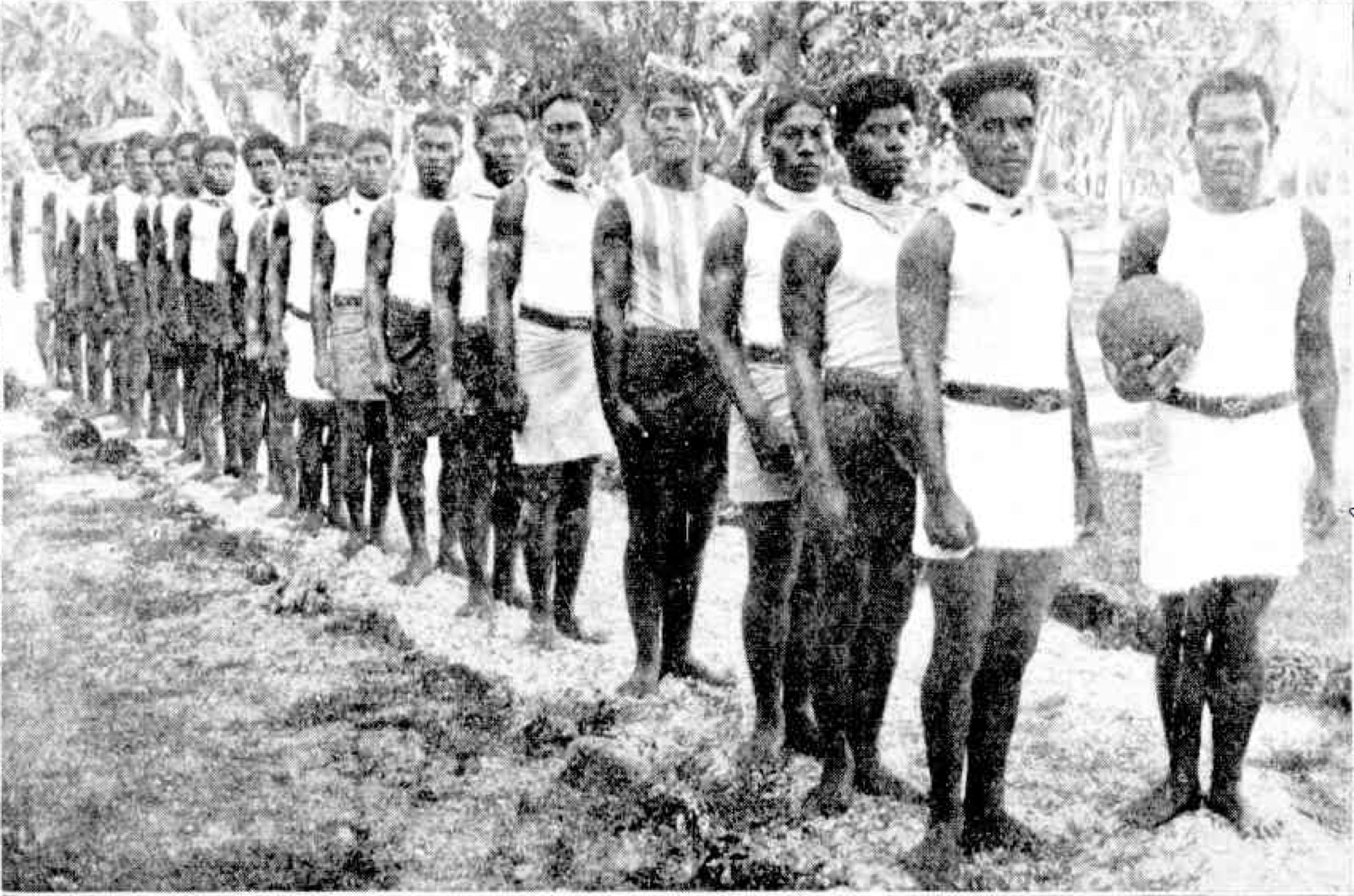
Australian rules football arrived during the first years of Australian rule. A photograph from 1919 shows a 20-man team of Nauruan police in sleeveless guernseys. Two Australians, W. Easton of Melbourne and W. H. St Claire, are credited with teaching the game to the islanders, organising regular matches and umpiring them. Rugby and soccer had arrived first, but it was the Australian game that Nauruans took to their hearts.
By the early 1920s a local competition was running, and reports in 1924 claimed that 250 of the island’s roughly 1,700 people were playing. The early rivalry between Boe and Denigomodu was modelled on the great Melbourne clubs — Boe on Carlton, Denigomodu on Collingwood.
The Geelong connection
From 1935, young Nauruans began travelling to Australia to study at Geelong Junior Technical School, in Victoria. There they were taken to watch league matches, and they brought their enthusiasm home. The link with the Geelong Football Club became a lasting tradition: for many years Geelong sent one of its players to umpire the Nauruan grand final. When the club legend Gary Ablett Sr. came in 1993, he drew a record crowd.
The ties ran both ways. In 1994, the struggling Fitzroy Football Club secured a loan of A$1.25 million from Nauru Insurance. When Fitzroy collapsed two years later, it defaulted — but after its merger with the Brisbane Bears to form the Brisbane Lions, the debt to Nauru was repaid in full.
A national game
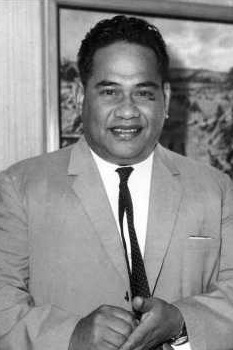
After independence in 1968, football became Nauru’s national sport. In 1976 a Nauruan national team toured Papua New Guinea, playing in front of more than 10,000 people in Port Moresby. They lost heavily, but the tour became part of the island’s sporting folklore. Several presidents of Nauru — among them Hammer DeRoburt, Bernard Dowiyogo, Derog Gioura and Marcus Stephen — played in the local league.
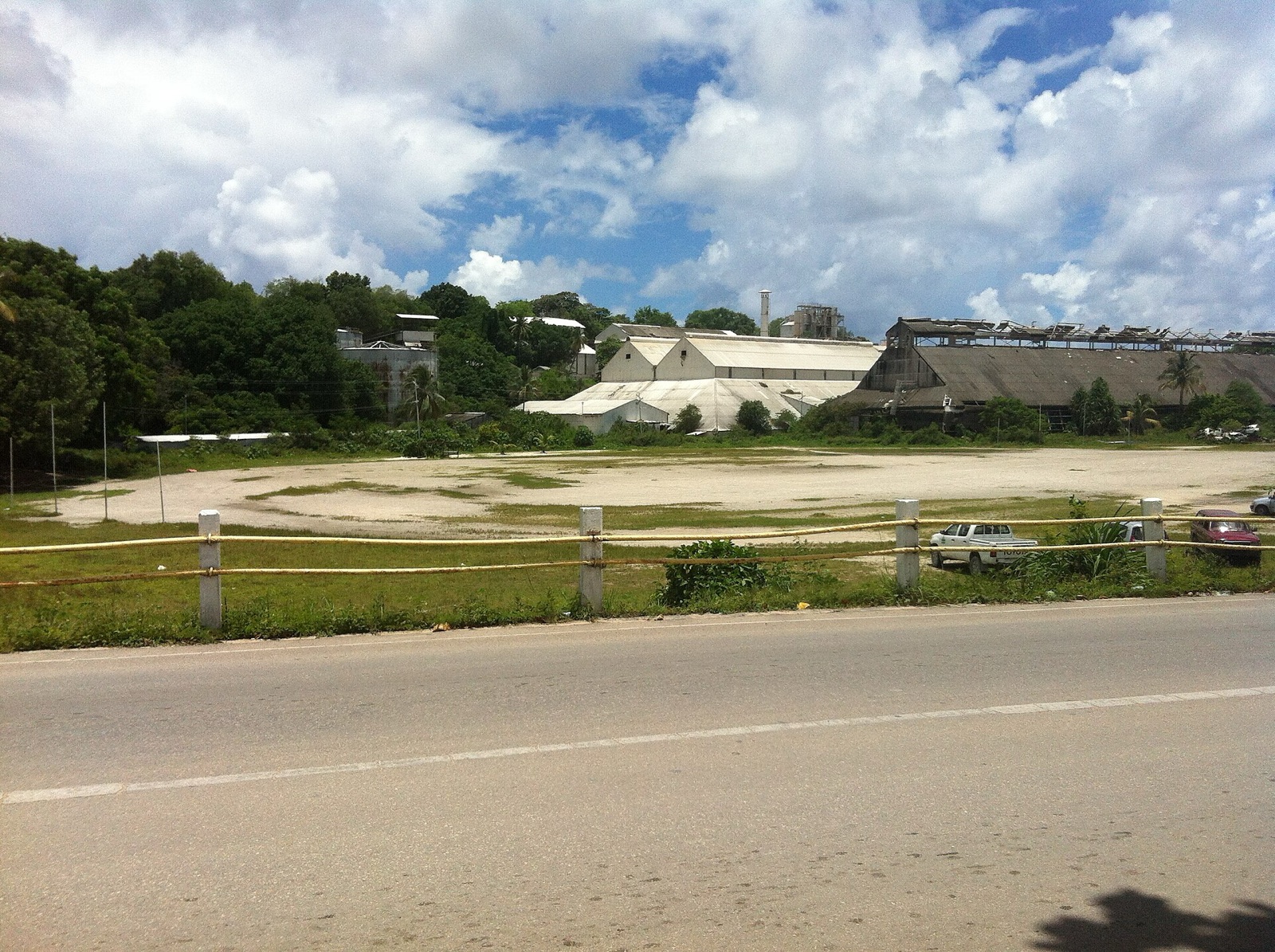
Home matches are played at Linkbelt Oval in Aiwo, the country’s only active stadium. Fittingly for an island built on phosphate, its playing surface is made of crushed phosphate dust rather than grass.
An island of lifters
If football is Nauru’s passion, weightlifting is its glory. The Nauru Olympic Committee was founded in 1991, and in 1994 the country was admitted to the International Olympic Committee, whose smallest member by population it remains. Nauru first competed at the Olympic Games in Atlanta in 1996, and every one of its Olympians before 2012 was a weightlifter.
The greatest of them was Marcus Stephen. At the 1990 Commonwealth Games in Auckland he was Nauru’s only competitor, and he won a medal in each of his three events, including gold. He went on to win three more golds in 1994 and another three in 1998, and competed at the Olympics in 1996 and 2000. In 2007 he became President of Nauru.
The class of 2002
Nauru’s finest hour came at the 2002 Commonwealth Games in Manchester. The team of weightlifters, which for the first time included women, won fifteen medals — ten of them by women. Six Nauruan lifters stood on the podium, an astonishing share of the country’s population. Reanna Solomon won two golds, becoming the first Nauruan woman to win Commonwealth gold.
The success continued. Itte Detenamo, who took up lifting at ten under his father’s guidance, won Commonwealth medals in 2006, 2010 and 2014 and competed at three Olympics. In 2010 Yukio Peter won gold in the 77 kg class in New Delhi, setting a Games record.
Remembering Reanna Solomon
In July 2022, Reanna Solomon died of COVID-19 at the age of 40 — the first person in Nauru to die of the disease. Tributes came from across the Pacific. A month later, at the Commonwealth Games in Birmingham, the Nauruan lifter Maximina Uepa won bronze and dedicated her medal to Solomon.
For a country with a single oval and a population smaller than many towns, Nauru’s sporting record is remarkable. It reflects something the island has always had in abundance: a stubborn refusal to be defined by its size.
Further reading
- Commonwealth Games Federation, results archives for Nauru, 1990–2022.
- Olympedia, “Nauru”, Olympic participation records.
- Rob Hess, Matthew Nicholson, Bob Stewart and Gregory de Moore, A National Game: The History of Australian Rules Football (Melbourne: Viking, 2008).