In the years after the Second World War, Nauru faced a question few colonised peoples have faced in quite the same way. Its land was being dug up and shipped away, tonne by tonne. The phosphate would one day run out — and then, the administering powers argued, the island would be unfit to live on. What would become of the Nauruans?
The answer the Nauruans eventually gave — independence, on their own island, with control of their own resources — was won through two decades of patient, stubborn negotiation. At the centre of it was one man: Hammer DeRoburt.
A trust territory
In 1947 Nauru became a United Nations trust territory, administered by Australia on behalf of Australia, Britain and New Zealand. On paper, the arrangement looked much like the old League of Nations mandate. In practice it offered Nauruans something new. The administering powers had to report regularly to the UN Trusteeship Council, which sent visiting missions to the island and could be petitioned directly.
The phosphate industry, meanwhile, carried on much as before. The British Phosphate Commissioners rebuilt the war-damaged works, and output was soon climbing again. Royalties paid to Nauruans rose, but they remained small compared with the value of the phosphate leaving the island.
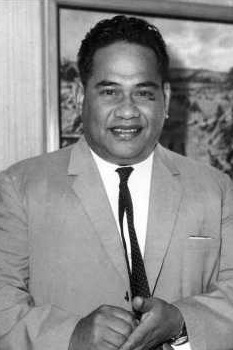
Hammer DeRoburt
Hammer DeRoburt was born in 1922 and trained as a teacher. He was among the Nauruans deported to Chuuk during the war, and after his return he became a leading figure in the community. In the mid-1950s he was chosen as Head Chief of the Nauru Local Government Council, the elected body set up in 1951 to represent Nauruans.
DeRoburt was a skilful negotiator: patient, well informed and immovable on the points that mattered. He understood that Nauru’s future depended on two things — political independence and control of the phosphate — and that the administering powers would have to be persuaded to concede both.
An island without a future?
The administering powers saw the future differently. Reports in the 1950s and early 1960s predicted that the phosphate would be exhausted before the end of the century, leaving an island whose interior was a wasteland of limestone pinnacles and whose narrow coastal strip could not support a growing population. The logical solution, they argued, was resettlement.
Several possible new homes were considered over the years. The most serious offer came from Australia in 1964: Curtis Island, off the coast of Queensland. The Nauruans would receive land and housing and become Australian citizens.
To the Nauruans, the offer missed the point. They would not have sovereignty over Curtis Island; they would be a small community inside Australia rather than a nation. Nauruan leaders wanted any new home to be theirs as an independent people. When it became clear that this would not be granted, they chose to stay where they were, and the Curtis Island proposal was rejected.
Winning the phosphate
The fight over phosphate mattered just as much as the fight for independence. Nauruans argued that they should receive the full value of their resource, not the cost-price arrangement that had benefited the three partner governments for decades. They also insisted that the partners take responsibility for the land that had already been mined.
The negotiations were long and difficult. In 1967 agreement was finally reached: Nauru would buy the phosphate industry’s assets on the island and take over its operation, with the transfer completed in 1970. The question of rehabilitating the mined-out land, however, was left unresolved — an issue Nauru would later pursue all the way to the International Court of Justice.
Independence Day
With the phosphate question settled, the way to independence was clear. The United Nations approved the end of the trusteeship, and Nauruans drew up a constitution for their new state.
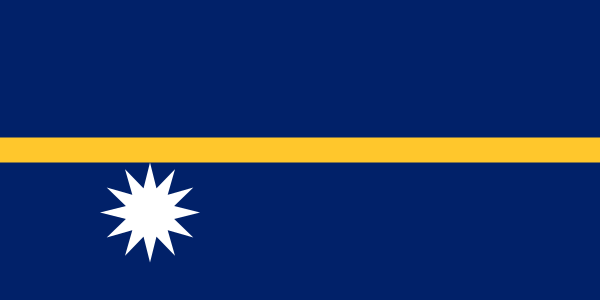
On 31 January 1968, Nauru became an independent republic. The date was chosen deliberately: it was the anniversary of the day in 1946 when the survivors of Chuuk had come home. Hammer DeRoburt became head of the new state and, soon afterwards, its first President.
The smallest republic
The new nation had a population of only a few thousand and an area of 21 square kilometres. It was the smallest republic in the world, and only the second Pacific Island nation to become independent, after Western Samoa in 1962. Its founding generation had achieved something remarkable. Faced with proposals that would have ended their existence as a people on their own land, they had instead won both their island and its wealth.
The challenge now was to use that wealth well, on an island whose greatest resource was running out. That story is told in Boom and Bust.
Further reading
- Nancy Viviani, Nauru: Phosphate and Political Progress (Canberra: ANU Press, 1970).
- Cait Storr, International Status in the Shadow of Empire: Nauru and the Histories of International Law (Cambridge University Press, 2020).
- Christopher Weeramantry, Nauru: Environmental Damage under International Trusteeship (Melbourne: Oxford University Press, 1992).