Biographies
Aweida
King of Nauru · c. 1875–1920
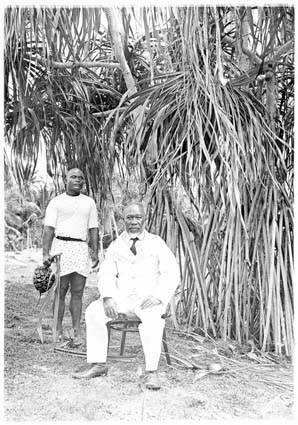
Aweida (also spelled Auweyida) was born around 1850 in Boe district, the son of a chief, and became the most prominent Nauruan leader of the late nineteenth century. He is described as the island’s king from about 1875, and as its de facto ruler during the Ten Years’ War of 1878–1888.
After German annexation ended the war, the colonial authorities recognised him as paramount chief, and he kept that standing into the first years of Australian control. He was noted for wearing Western dress on special occasions, a rarity on the island at the time. Aweida drowned near the Gabab Channel in 1920 and was succeeded by his son, Moses.
Timothy Detudamo
Head Chief · 1930–1942, 1946–1953 · 1888–1953
Timothy Detudamo was born in Uaboe district in 1888 and was among the first Nauruans to become Christian after missionaries arrived in 1899. Working with the missionary Philip Delaporte, he helped devise a written alphabet for the Nauruan language and translate the New Testament, published in 1907, and he later spent 1915–1918 in the United States working on a translation of the whole Bible. He spoke German, English, Gilbertese and Marshallese as well as Nauruan.
In November 1930 the Administrator, William Newman, appointed him Head Chief. He continued to lead the community under Japanese occupation until 30 June 1943, when he was deported to Chuuk with the first group of Nauruans. He returned with the survivors on 31 January 1946 and resumed his role, and in 1951 he became the first Head Chief chosen by the new Local Government Council. He also helped found the Nauru Cooperative Society, a store owned by Nauruan landowners. He died in Sydney in April 1953.
Raymond Gadabu
Head Chief · 1953–1955 · 1921–1964
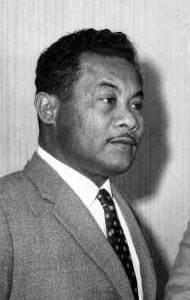
Raymond Gadabu, of the Iruwa clan, was educated in Nauru and at colleges in Geelong and Melbourne, and worked in Australia as a clerk and salesman during the Second World War. He joined the Nauruan civil service in 1945.
Elected to the first Nauru Local Government Council for Aiwo in 1951, he succeeded Timothy Detudamo as Head Chief after Detudamo’s death in 1953. He held the post until 1955, when Hammer DeRoburt replaced him, and from 1954 he also served as a Nauruan Affairs officer and a magistrate of the Nauru District Court. He died in 1964.
Hammer DeRoburt
Head Chief 1956–1968 · President 1968–1976, 1978–1989 · 1922–1992
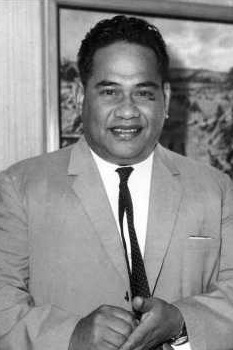
Hammer DeRoburt was born in 1922 and educated in Nauru and at the Gordon Institute of Technology in Geelong, Australia. He worked as a schoolteacher, and during the Second World War he was deported to Chuuk with most of the Nauruan population. After returning in 1946 he joined the Department of Education, was elected to the Local Government Council in 1955, and became Head Chief in 1956.
From 1962 he led the campaign for independence, calling for sovereignty before the United Nations Trusteeship Council and leading the Nauruan side in the talks of 1965–1967. The Nauruans rejected resettlement and won control of the phosphate industry — DeRoburt signed the agreement in June 1967 — and Nauru became independent on 31 January 1968. That May he was elected the republic’s first President. Read more in The Road to 1968.
As President he established the Nauru Phosphate Corporation, Air Nauru and a national shipping line, and his government took Nauru’s case over its mined-out lands to the International Court of Justice in 1989. With short breaks in 1976–1978 and 1986, he led the country until August 1989. He received an honorary knighthood in 1982, is credited with popularising Australian rules football on the island, and died in Melbourne in 1992.
Franz Leopold Sonnenschein
Imperial Commissioner · 1888
Franz Leopold Sonnenschein held the title of Reichskommissar, or Imperial Commissioner, when Germany formally annexed Nauru on 2 October 1888. His authority on the island lasted only a day before a resident district officer took charge.
The annexation he presided over, which disarmed the island’s warring clans and banned alcohol, brought the Ten Years’ War to an end and began eight decades of colonial rule. Read more in Pleasant Island.
Robert Rasch
District officer (acting) · 1888–1889
Robert Rasch became Nauru’s first resident German official the day after annexation, serving as acting district officer (Bezirksamtmann) from 3 October 1888 to 14 May 1889. His months in charge were the first of German rule, as the bans on firearms and alcohol that had ended the civil war took effect.
Christian Hermann Johannsen
District officer · 1889–1892
Christian Hermann Johannsen succeeded Robert Rasch in May 1889 and served as district officer until 1892. These were the first full years of German rule, a period of recovery after the civil war, when the trade in copra — dried coconut — was the island’s main link with the outside world.
Friedrich “Fritz” Jung
District officer · 1892–1897
Friedrich “Fritz” Jung was district officer from 1892 to 1897. Nauru was then a small and remote outpost of Germany’s Marshall Islands Protectorate, valued mainly for its copra. The phosphate that would transform the island had not yet been discovered.
Ludwig Kaiser
District officer · 1898–1905
Ludwig Kaiser served as district officer from 1898 to 1905, years of rapid change. The Protestant missionary Philip Delaporte arrived in 1899, and in 1900 the prospector Albert Ellis confirmed that the island held vast deposits of high-grade phosphate. The arrangements between British and German interests that allowed it to be mined were worked out during his term. Read more in The Doorstop That Changed an Island.
Konrad Geppert
Station chief · 1906–1908
Konrad Geppert took charge on 1 April 1906, the first official to hold the title of station chief after Germany reorganised its administration in the region. His arrival coincided with the start of large-scale phosphate mining by the Pacific Phosphate Company, whose first shipments left the island in 1907.
Joseph Siegwanz
Station chief · 1908–1911
Joseph Siegwanz was station chief from 1908 to 1911, as the phosphate industry expanded rapidly. Labourers recruited from China and from other Pacific islands arrived to work in the mines, and the landscape of Topside began to change as the digging spread.
Karl Warnecke
Station chief · 1911–1912
Karl Warnecke served briefly as station chief from 1911 to 1912, during the steady growth of the phosphate industry in the final years of German rule.
Wilhelm Wostrack
Station chief · 1912–1914
Wilhelm Wostrack was the last German official to govern Nauru. Station chief from 1912, he was in charge when the First World War broke out in 1914. After a British naval landing party came ashore for a few hours on 9 September 1914, he resumed his duties until Australian forces arrived to take control of the island on 6 November 1914, ending twenty-six years of German rule.
Myles Aldington Blomfield
Commander, British landing party · 1914
Myles Aldington Blomfield commanded the British naval landing party that came ashore on Nauru on 9 September 1914, a month after the outbreak of the First World War. His authority over the island lasted only a matter of hours, but it signalled the end of German rule: the German station chief carried on only until Australian troops arrived in November.
William Holmes
Commander, Australian expeditionary force · 1914 · 1862–1917
William Holmes commanded the Australian Naval and Military Expeditionary Force, raised in August 1914 to seize Germany’s colonies in the Pacific. After accepting the surrender of the German governor of New Guinea in September 1914, his force took control of Nauru on 6 November.
Holmes later served on the Western Front as a major general. He was killed by a German shell in July 1917 while visiting the battlefield at Messines, in Belgium, and was buried in France.
Edward Creer Norrie
Commander, Australian garrison · 1914
Edward Creer Norrie commanded the Australian garrison that occupied Nauru from 6 November 1914. He governed the island through the first weeks of Australian control, until the first Administrator took over on 25 December 1914.
Charles Rufus Marshall Workman
Administrator · 1914–1917
Charles Rufus Marshall Workman became Nauru’s first Administrator under Australian occupation on 25 December 1914. He governed through most of the First World War, while the Pacific Phosphate Company continued mining the island under its new flag.
Geoffrey Whistler Bingham Smith-Rewse
Administrator · 1917–1921
Geoffrey Whistler Bingham Smith-Rewse was Administrator from December 1917 to June 1921, years that settled Nauru’s future for half a century. The Nauru Island Agreement of 1919 placed the phosphate industry in the hands of the British Phosphate Commissioners; in 1920 the League of Nations confirmed Nauru as a mandated territory; and the same year an influenza epidemic killed an estimated 18 per cent of Nauruans.
Thomas Griffiths
Administrator · 1921–1927 · 1865–1947
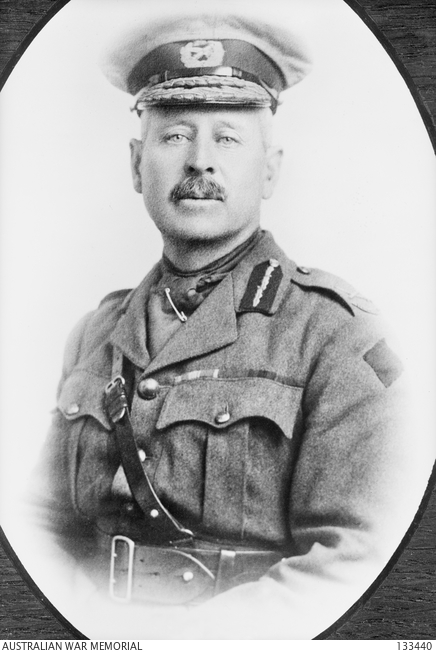
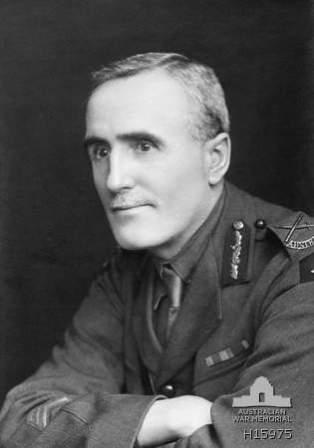
Thomas Griffiths was a Welsh-born Australian army officer. He joined the Victorian Permanent Artillery in 1886, served at Gallipoli in 1915, and commanded the headquarters of the Australian Imperial Force in London from 1917 to 1919, rising to the rank of brigadier general.
He was Administrator of Nauru from June 1921 to June 1927, in the early years of the League of Nations mandate and the British Phosphate Commissioners. He also served twice as Administrator of the Australian territory of New Guinea, and died in Melbourne in 1947.
William Augustin Newman
Administrator · 1927–1932
William Augustin Newman was Administrator from June 1927 to the end of 1932. In November 1930 he appointed Timothy Detudamo as Head Chief of Nauru, a role Detudamo would hold, with an interruption during the war, until 1953. The first Angam, when the Nauruan population recovered to 1,500 in October 1932, came near the end of his term.
Daniel Eberhardt
Acting Administrator · 1933 · c. 1885–1951
Daniel Eberhardt was born in Australia and enlisted in the Royal Australian Navy, serving in the First World War. After returning home he trained as an accountant and took a post on Nauru as the island’s accountant and customs official. According to his family, the island’s isolation weighed on him, and he struggled with alcohol.
When Administrator William Newman left Nauru at the end of 1932, Eberhardt stepped in as acting Administrator. He led the island for 17 days, from 1 to 17 January 1933, until Rupert Clare Garsia arrived to take over, and he left Nauru shortly afterwards.
Eberhardt retired to Sydney with his wife, Evie. He died in his sleep on 1 December 1951, aged 66.
Rupert Clare Garsia
Administrator · 1933–1938
Rupert Clare Garsia was Administrator from January 1933 to August 1938, years of rising phosphate production and a slowly recovering Nauruan population. In 1936 a language committee that included Head Chief Timothy Detudamo was appointed to standardise the spelling of Nauruan.
Frederick Royden Chalmers
Administrator · 1938–1942 · d. 1943
Frederick Royden Chalmers became Administrator in October 1938 and was in charge when the Second World War reached Nauru. German raiders sank phosphate ships and shelled the island in December 1940, and Japanese forces landed on 26 August 1942.
Chalmers remained on the island and was taken prisoner. On 25 March 1943, after the first Allied air raids on the new Japanese airstrip, he and four other Australians held on Nauru were killed by their captors. Read more in Exile to Chuuk.
Hiromi Nakayama
Military commander · 1942–1943
Hiromi Nakayama commanded the Japanese forces that occupied Nauru on 26 August 1942. During his command the garrison began fortifying the island, and work started on the airstrip that Allied aircraft would later bomb repeatedly. Nauruans, and the handful of Europeans who had stayed, came under Japanese military rule.
Takenao Takenouchi
Military commander · 1943
Takenao Takenouchi, commander of the 67th Naval Guard Unit, took charge of Nauru on 7 March 1943. His months in command coincided with two of the darkest events of the occupation: the killing of the Administrator, Frederick Chalmers, and four other Australians on 25 March, and the deportation of the first group of Nauruans to Chuuk on 30 June. Read more in Exile to Chuuk.
Hisayuki Soeda
Military commander · 1943–1945
Hisayuki Soeda, also commander of the 67th Naval Guard Unit, governed Nauru from July 1943 until the end of the war. Later in 1943 a second group of Nauruans was sent to Chuuk, while the garrison and the islanders who remained endured blockade, bombing and hunger as the Allied advance bypassed the island.
His command ended with the surrender of the Japanese garrison to Australian forces on 13 September 1945.
Joseph Lawrence Andrew Kelly
Military administrator · 1945
Joseph Lawrence Andrew Kelly served as military administrator after the Japanese surrender, governing Nauru through the first weeks of Australian reoccupation in September and October 1945.
Mark Ridgway
Administrator · 1945–1949
Mark Ridgway was the first civilian Administrator after the war, serving from November 1945 to August 1949. His term saw the return of the survivors of Chuuk on 31 January 1946, the rebuilding of the war-damaged phosphate works, and the beginning of United Nations trusteeship in 1947.
Harold Reeve
Acting Administrator · 1949
Harold Reeve served as acting Administrator for almost four months in 1949, between the terms of Mark Ridgway and Robert Richards.
Robert Stanley Richards
Administrator · 1949–1952 · 1885–1967
Robert Stanley Richards was a Labor politician from Moonta, South Australia, who represented the seat of Wallaroo in the state parliament for more than thirty years. He briefly served as Premier of South Australia in 1933 and later led the state’s Labor opposition.
Appointed Administrator of Nauru in December 1949, he brought his new wife with him to the island. During his term the Nauru Local Government Council was established in 1951, giving Nauruans an elected body of their own. He later returned to Adelaide, where he ran a radio station and served on the state forestry board.
John Keith Lawrence
Acting Administrator · 1952–1954
John Keith Lawrence acted as Administrator from July 1952. His time in charge included the death of Head Chief Timothy Detudamo in April 1953 and the choice of Raymond Gadabu as his successor.
Keith Alan Read
Acting Administrator · 1953–1954
Keith Alan Read also served as acting Administrator in 1953–1954, in the period before Reginald Leydin took up the post in July 1954.
Reginald Sylvester Leydin
Administrator · 1954–1958, 1962–1966
Reginald Sylvester Leydin served two terms as Administrator, from July 1954 to June 1958 and again from June 1962 to March 1966. His first term saw the Local Government Council gain control of the Nauru Royalties Fund and Hammer DeRoburt become Head Chief.
His second spanned the most important years of the independence campaign, including the rejected offer to resettle the Nauruan people on Curtis Island in 1964 and the opening of the talks that would lead to independence. Read more in The Road to 1968.
John Preston White
Administrator · 1958–1962
John Preston White was Administrator from June 1958 to April 1962, years in which debate grew over what would become of Nauru and its people once the phosphate ran out, and the administering powers began to consider resettling the population elsewhere.
Frederick William McConaghy
Acting Administrator · 1962
Frederick William McConaghy served as acting Administrator for one month, in May 1962, before Reginald Leydin returned for a second term.
Roy Edward Vizard
Acting Administrator · 1966
Roy Edward Vizard was acting Administrator for about two months in 1966, between Reginald Leydin’s departure and the arrival of Leslie King, who would be Nauru’s last Administrator.
Leslie Dudley King
Administrator · 1966–1968
Leslie Dudley King was the last Administrator of Nauru, arriving in May 1966 as negotiations over the island’s future reached their climax. His term saw the June 1967 agreement to hand the phosphate industry to Nauru and the decision to end the United Nations trusteeship. It ended on 30 January 1968 — the day before Nauru became independent.
Bernard Dowiyogo
President · 1976–1978, 1989–1995, 1996, 1998–1999, 2000–2001, 2003 · 1946–2003
Bernard Dowiyogo was born in Ubenide district in 1946 and trained as a lawyer. First elected to Parliament in 1973, he became President in December 1976 at the age of 30, the youngest person to hold the office. He went on to hold the presidency seven separate times — more than anyone else in Nauru’s history — representing first the Nauru Party and later the Democratic Party of Nauru.
His longest term, from 1989 to 1995, spanned Nauru’s case against Australia at the International Court of Justice and the 1993 settlement, as well as the economic troubles that grew as phosphate declined. In his final term his government moved to close Nauru’s offshore banks after American allegations of money laundering. He died in office on 9 March 2003 in Washington, D.C., where he had gone for medical treatment.
Lagumot Harris
President · 1978, 1995–1996 · 1938–1999
Lagumot Harris was born in 1938 and represented Ubenide in Parliament, holding a series of ministerial posts over several decades. His first presidency, from 19 April to 15 May 1978, lasted less than a month — an early sign of the frequent changes of government that would follow.
He returned as President from November 1995 to November 1996, and afterwards served as Minister of Finance under Ruben Kun. He was a cousin of René Harris, who also became President. He died in Melbourne in 1999.
Kennan Adeang
President · 1986, 1996 · 1942–2011
Kennan Adeang was born in 1942 and studied at the Australian School of Pacific Administration before entering Parliament for Ubenide in 1971. In 1987 he helped establish the Democratic Party of Nauru.
He was President three times, each time briefly and each time ending in a vote of no confidence: for two weeks in September and October 1986, again in December 1986, and for 24 days in November and December 1996. He later served as Minister of Finance, as Speaker of Parliament and, from 2007 to 2011, as High Commissioner to Fiji. His son, David Adeang, became President in 2023.
Kenas Aroi
President · 1989 · 1942–1991
Kenas Aroi represented Boe in Parliament from independence in 1968 until his death, served as Speaker from 1971 to 1977, and was Minister of Finance under both Bernard Dowiyogo and Hammer DeRoburt. He had also worked with the Nauru Phosphate Corporation.
He became President in August 1989 with the support of Kennan Adeang, ending DeRoburt’s long period in power. After suffering a stroke that November, he did not seek re-election and handed over to Bernard Dowiyogo in December 1989. He died in 1991.
Ruben Kun
President · 1996–1997 · 1942–2014
Ruben Kun was a lawyer who represented Buada in Parliament for more than two decades and served as Speaker from 1981 to 1986. He held the finance portfolio several times under different governments.
He was President for eight weeks, from December 1996 to February 1997, during one of the most unsettled periods in Nauruan politics. In later years he acted as a lawyer for asylum seekers held on Nauru, representing detainees in a Supreme Court case over Australia’s offshore processing policy.
Kinza Clodumar
President · 1997–1998 · 1945–2021
Kinza Clodumar was born in Boe in 1945, during the Japanese occupation. He founded and led the Centre Party, and is the only Nauruan politician to have been elected to Parliament for two different constituencies, Aiwo and Boe.
A long-serving Minister of Finance under several presidents, he was President himself from February 1997 until June 1998, when he was removed by a vote of no confidence. He received a state funeral after his death in 2021.
René Harris
President · 1999–2000, 2001–2003, 2003–2004 · 1947–2008
René Harris was born in Aiwo in 1947 and educated at Geelong College in Australia. He spent much of his career in the phosphate industry, managing the Nauru Pacific shipping line and becoming chairman of the Nauru Phosphate Corporation in 1992, and he represented Aiwo in Parliament for 31 years.
He was President four times between 1999 and 2004. His governments saw Nauru join the United Nations and the Commonwealth, agreed in 2001 to host Australia’s offshore processing centre, and switched recognition from Taiwan to China in 2002 — but they also presided over a deepening financial crisis and faced international criticism over passport sales and offshore banking. He lost his seat in 2008 and died later that year.
Derog Gioura
President · 2003 · 1932–2008
Derog Gioura represented Ubenide in Parliament across four decades, served as Speaker from 1987 to 1992, and held senior ministerial posts under several presidents, including Minister of Finance.
After Bernard Dowiyogo died in office in March 2003, Gioura became acting President and then President, serving until the end of May 2003 in one of the most unstable periods in Nauru’s politics. He spent part of his time in office receiving medical treatment in Australia. He died in 2008.
Ludwig Scotty
President · 2003, 2004–2007 · 1948–2026
Ludwig Scotty was born in Anabar in 1948 and became one of Nauru’s most experienced parliamentarians, serving as Speaker of Parliament in five separate spells between 2000 and 2016.
He was first elected President in May 2003, defeating Kinza Clodumar by ten votes to seven, but was ousted in a vote of no confidence that August. Returning in June 2004, he led a reforming government through the recovery from the country’s financial collapse, and was re-elected in 2007 with the support of 14 of Parliament’s 18 members before losing a vote of no confidence that December. He died in February 2026, aged 77.
Marcus Stephen
President · 2007–2011 · born 1969
Before politics, Marcus Stephen was one of the Pacific’s greatest weightlifters. Born in 1969, he competed at three Olympic Games, won seven Commonwealth Games gold medals between 1990 and 1998, and took silver at the 1999 World Championships. In 2005 he was inducted into the International Weightlifting Federation Hall of Fame.
Elected to Parliament for Anetan in 2003, he served as a minister before becoming President in December 2007. His presidency was marked by political deadlock, including states of emergency in 2008 and 2010. He resigned in November 2011 amid allegations of corruption, and later returned to Parliament, becoming Speaker in 2019.
Freddie Pitcher
President · 2011 · born 1967
Freddie Pitcher studied Pacific studies at Macquarie University in Sydney and served as Nauru’s deputy representative at the United Nations in New York before entering Parliament in 2004, where he held the commerce and finance portfolios.
He became President on 10 November 2011 after Marcus Stephen’s resignation, but lost a vote of confidence five days later. After leaving Parliament he returned to diplomacy, and in 2025 became Nauru’s representative to the United Nations in Geneva and ambassador to Switzerland.
Sprent Dabwido
President · 2011–2013 · 1972–2019
Sprent Dabwido represented Meneng in Parliament from 2004 and served as Minister for Telecommunications before becoming President in November 2011, elected by nine votes to eight. He was a prominent voice for small island states at the 2011 United Nations climate change conference, calling for a legally binding agreement on emissions, and his government supported the reopening of Australia’s processing centre on Nauru in 2012.
He did not seek re-election as President in 2013. He later became a critic of the government, taking part in anti-government protests in 2015, and lost his seat in 2016. Diagnosed with cancer, he sought treatment in Australia, where he spoke out against the processing centre he had once supported. He died in 2019, aged 46.
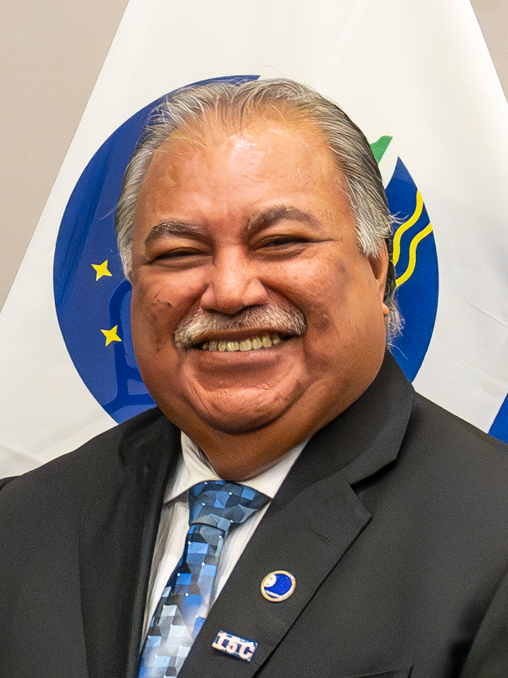
Baron Waqa
President · 2013–2019 · born 1959
Baron Waqa was born in Boe in 1959 and educated at the University of the South Pacific in Fiji and Monash University in Melbourne. He represented Boe in Parliament from 2003 to 2019 and served as Minister of Education under Ludwig Scotty.
As President from 2013 to 2019 he hosted the 2018 Pacific Islands Forum, which adopted the Boe Declaration on regional security. His government also drew international criticism, notably over the removal of the country’s Australian magistrate and chief justice in 2014. He lost his seat in the 2019 election, and in June 2024 he became Secretary General of the Pacific Islands Forum.
Lionel Aingimea
President · 2019–2022 · born 1965
Lionel Aingimea studied law in Australia and worked as a public defender in the Marshall Islands and a lecturer at the University of the South Pacific before becoming Nauru’s Secretary for Justice. He was elected to Parliament for Meneng in 2016.
Parliament chose him as President in August 2019, by twelve votes to six over David Adeang, and he led Nauru through the COVID-19 pandemic until 2022. He later served as Deputy Speaker and as a senior minister under Adeang, and in April 2026 he became Nauru’s first Vice President, a post created by constitutional reform.
Russ Kun
President · 2022–2023 · born 1975
Russ Kun spent much of his career in the public service, including senior acting roles in several ministries and as acting Chief Secretary, before entering Parliament for Ubenide in 2013. He served as a deputy minister under Lionel Aingimea.
He was elected President unopposed in September 2022. That November he made a state visit to Taiwan, and in 2023 he reaffirmed Nauru’s support for Taiwan at the United Nations General Assembly. He lost a vote of no confidence in October 2023; within months, his successor switched recognition to China.
David Adeang
President · 2023–present · born 1969
David Adeang was born in Yaren in 1969, the son of former President Kennan Adeang. First elected to Parliament for Ubenide in 2001, he has held many of the country’s senior offices, including Speaker of Parliament and Minister of Finance, Foreign Affairs and Justice, and was a leading minister throughout Baron Waqa’s government.
He became President on 30 October 2023, after a vote of no confidence against Russ Kun. In January 2024 his government switched Nauru’s diplomatic recognition from Taiwan to the People’s Republic of China, and in December 2024 it signed a wide-ranging treaty with Australia covering security, banking and budget support. Read more in Modern Nauru.