Nauru’s own name for its language is dorerin Naoero, “the language of Nauru”. It is spoken as a mother tongue nowhere else on earth. For thousands of years it lived only in speech — in chants, stories, genealogies and everyday talk — and it was not written down until the very end of the nineteenth century.
An island’s own tongue
Nauruan belongs to the great Austronesian family of languages, which stretches from Madagascar to Hawai‘i and Easter Island. It is usually placed among the Micronesian languages of the central Pacific, but it is an unusual member of the group, and linguists have long debated exactly how it relates to its neighbours.
To an outsider’s ear, its sounds can be subtle. Nauruan distinguishes between consonants spoken with the tongue drawn back and those spoken with it pushed forward, and it has twelve vowels — six short and six long — where English speakers might hear only a handful.
Many voices, one island
Nauru is small enough to walk around in an afternoon, yet its language was once surprisingly varied. According to a report published in Sydney in 1937, before Germany annexed the island in 1888 the speech of different districts had drifted so far apart that people from one part of the island sometimes struggled to understand people from another.
That changed once Nauruan began to be written and printed. As books, schooling and church services spread a single written form, the old dialects blended into a common standard. Today there is little regional variation; the speech of Yaren and its neighbourhood is one of the few recognisable local varieties.
Putting it on paper
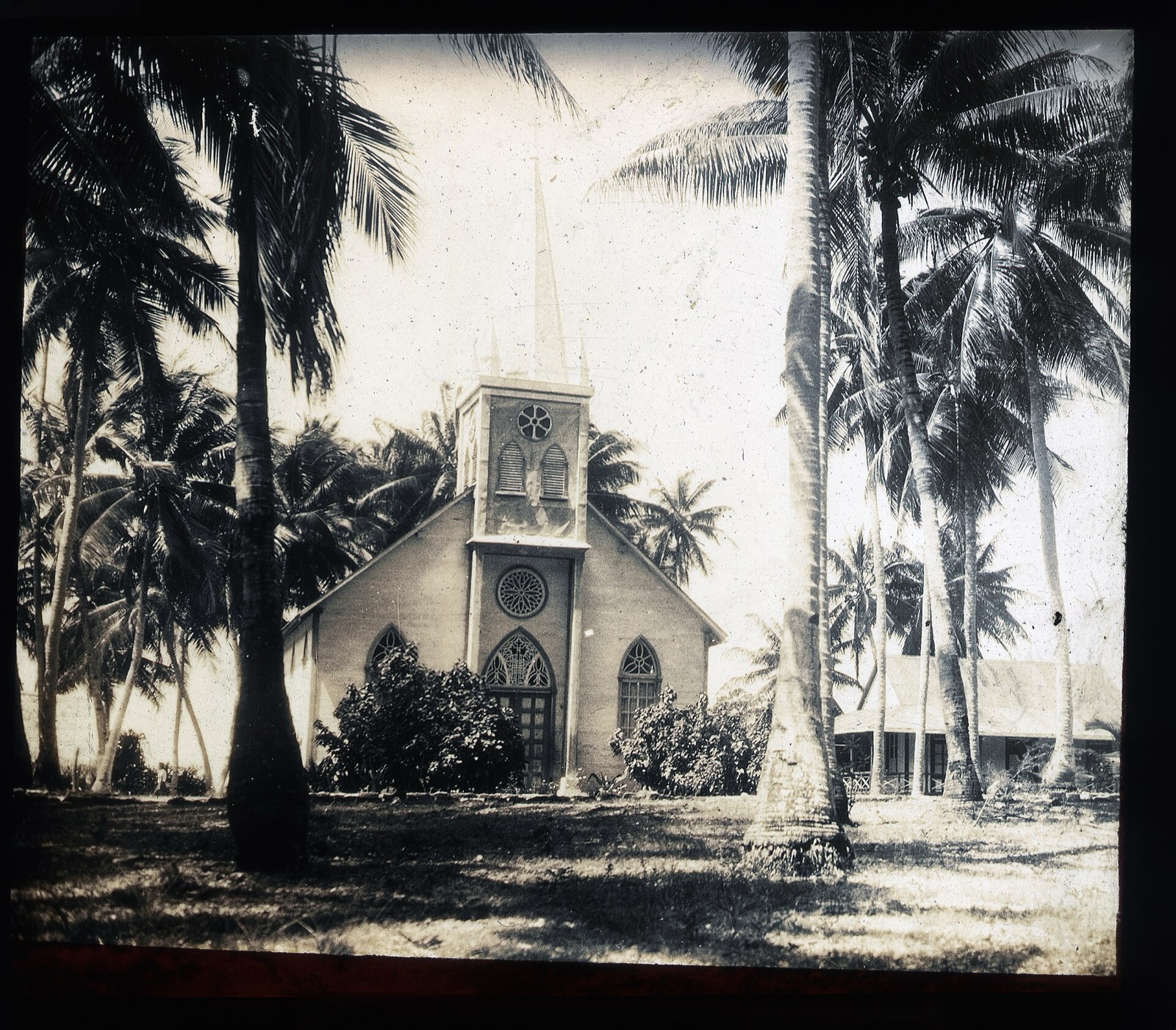
Writing came to Nauru later than to many Pacific islands. A Gilbertese pastor named Tabuia founded a Christian mission on the island in the late 1880s, but he withdrew in 1892 at the request of the German authorities, leaving behind a small group of Nauruan converts.
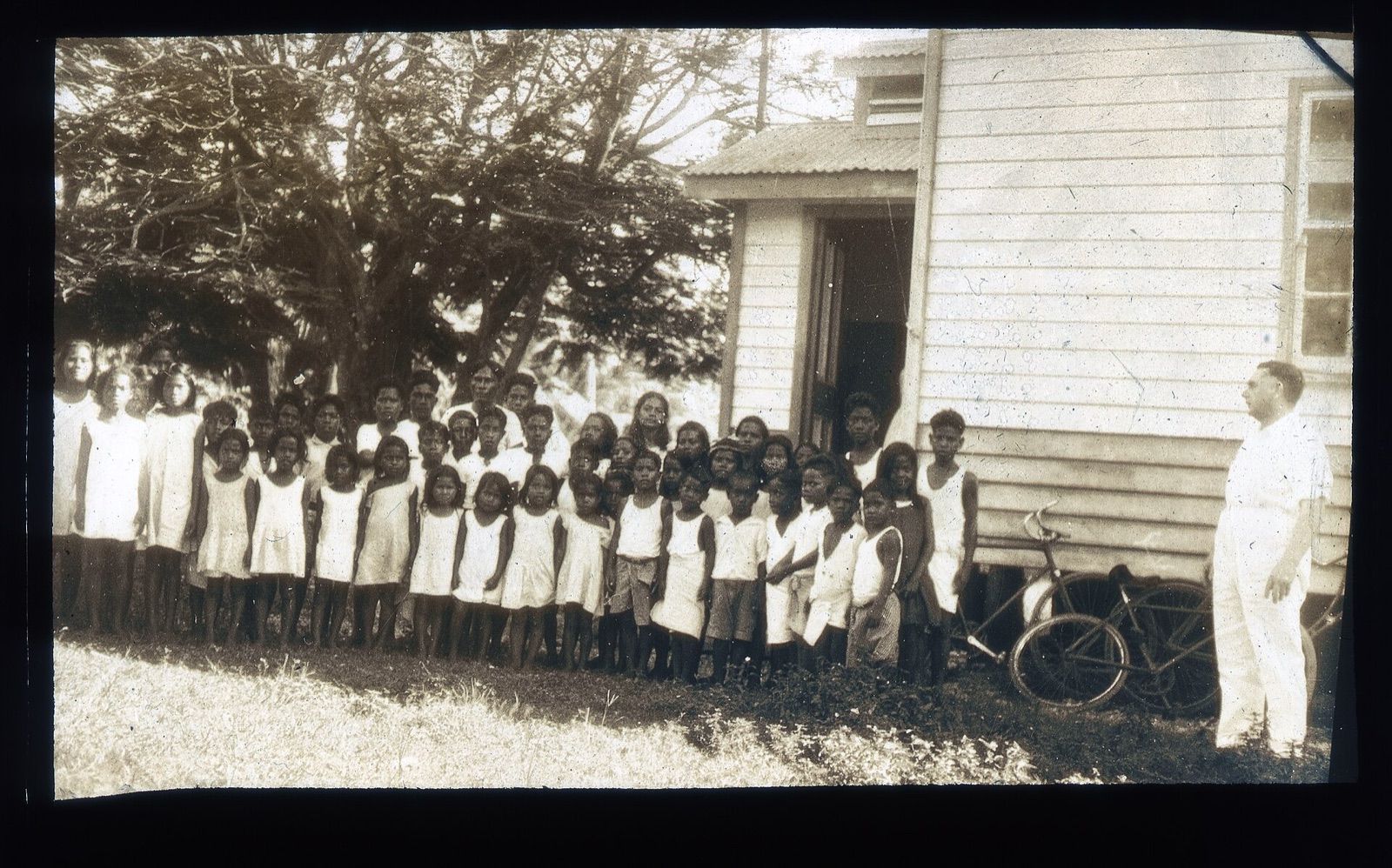
In 1899 a German-born American missionary, the Reverend Philip Delaporte, arrived with his wife Salome to take charge of the mission and its school — the only formal school on the island. Delaporte set about creating an alphabet for Nauruan. The first version used just seventeen letters: the five vowels a, e, i, o, u and twelve consonants, b, d, g, j, k, m, n, p, q, r, t and w. From 1900 the mission began producing reading primers for Nauruan schoolchildren, copied on a mimeograph machine.
A printing press and a Bible
In 1906 the mission obtained a printing press from Sydney and began training Nauruan converts to run it. Two of them, Timothy Detudamo and Jacob Aroi, became Delaporte’s closest collaborators. That same year the press produced the first printed book in Nauruan, Toranab in Bibel, a collection of Bible stories, in a run of 400 copies.
In 1907 Delaporte, Detudamo and Aroi completed a Nauruan translation of the New Testament, remembered as a landmark in the history of the language. Delaporte also published a pocket German–Nauruan dictionary that year, glossing some 1,650 German words — often described as the first scholarly publication on Nauruan.
When Delaporte left Nauru for the United States in 1915, the island’s people raised $500 so that Detudamo could travel with him and finish their work. The complete Nauruan Bible was finally published in 1918. Detudamo went on to become Head Chief of Nauru and one of the most important Nauruan leaders of the colonial era.
Rival grammars
Delaporte was not the only outsider to study the language. The German ethnologist Paul Hambruch, who visited Nauru in 1909 and 1910, published a Nauruan grammar and vocabulary as part of a larger study of the island. Father Alois Kayser, a Catholic missionary who spent almost forty years on Nauru, was sceptical of both men’s work and began a grammar of his own. It was finally completed in 1936 and published by the Australian administration.
Kayser’s own story ended in tragedy. In 1943 he was deported to Chuuk by the Japanese along with most of the Nauruan people, and he died there in 1944. Nauru later named its technical school, in Ewa, in his honour.
The reforms of 1938
By the 1930s written Nauruan had become a patchwork of competing spellings. In 1936 the Australian administration set up a Language Committee to sort it out. Its recommendations were officially adopted on 5 November 1938. Among them: the letter ñ became ng; the combinations bu and qu became bw and kw; ts became j; and the German names for the days of the week and months of the year, still in everyday use, were replaced with English ones.
The reforms only partly took hold. Nauruans adopted ng, bw and kw, but kept writing some vowels with a tilde, as in õ and ũ, rather than the circumflex the committee proposed. Some place names never changed at all: the districts of Baiti and Ijuw are still spelled the old way, rather than the reformed Beiji and Iyu.
Borrowed words
Nauruan carries the marks of every power that has passed through the island. German missionaries filled gaps in the vocabulary with German words — the Nauruan Bible calls God Gott — and English, Gilbertese and other languages have all left their traces. Over time, the alphabet itself grew to around thirty letters to cope with the new words.
Today Nauruan remains the language of home, family and community, while English is widely used in government, business and education. In a nation of around 12,000 people, keeping a language alive is never guaranteed. But the story of how Nauruan came to be written — largely through the work of Nauruans themselves — is one of the quiet achievements of the island’s history.
Further reading
- Alois Kayser, Nauru Grammar, ed. Karl H. Rensch (Canberra: Embassy of the Federal Republic of Germany, 1993).
- Geoffrey S. Nathan, “Nauruan in the Austronesian Language Family”, Oceanic Linguistics 12 (1974).
- Paul Hambruch, Nauru, 2 vols (Hamburg: Friederichsen, 1914–15).