Some of history’s great turning points are accidents. Nauru’s came in an office in Sydney where, at the end of the nineteenth century, a heavy lump of rock was being used as a doorstop.
The office belonged to the Pacific Islands Company, a British firm trading in copra and guano across the Pacific. The rock had been brought back from Nauru some years earlier by one of the company’s officers, who took it to be a piece of petrified wood. Nobody had thought it worth a closer look.
A second look
In 1899, a New Zealander named Albert Ellis, who worked for the company assessing guano and phosphate deposits, noticed the rock. It reminded him of phosphate samples he had seen from other Pacific islands, and he had it tested. The result was startling: the “petrified wood” was phosphate rock of exceptionally high grade.
Phosphate was one of the most sought-after commodities of the age. It was the key ingredient of superphosphate fertiliser, which was transforming farming in Australia and New Zealand, where soils were often naturally poor in phosphorus. A large, rich deposit was worth a fortune.
Two islands
Ellis set out to find the source. In 1900 he landed on Banaba, also known as Ocean Island, some 300 kilometres east of Nauru, and confirmed that it was rich in phosphate. He then visited Nauru and found the same: the island’s central plateau was covered in some of the highest-grade phosphate rock ever found.
Banaba was brought under British control almost at once. Nauru was a different matter. It was German territory, and any mining there would need German agreement.
A German island, a British company
The solution was a commercial deal. The German Jaluit Company held the rights to exploit resources in the Marshall Islands Protectorate, which included Nauru. In 1902 the Pacific Islands Company was reorganised as the Pacific Phosphate Company, and an agreement was reached under which it could mine Nauru in return for payments to the German concession holders.
Mining on Nauru began in 1906, and the first shipments left the island in 1907.
Digging between the pinnacles
Mining in the early years was grindingly physical. The phosphate lay in pockets between tall pinnacles of coral limestone, and it had to be dug out by hand with picks and shovels, loaded into baskets and small rail wagons, and hauled to the coast. Labourers were recruited from China and from other Pacific islands.
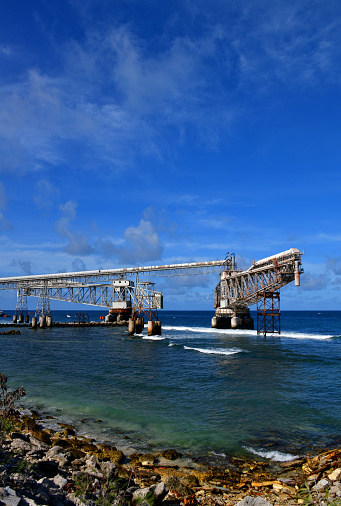
Loading was just as hard. Nauru had no harbour, and the reef kept large ships away from the shore. Ships moored at deep-water buoys offshore and the phosphate was ferried out to them — until, in time, great steel cantilevers were built out over the reef to pour phosphate straight into the waiting holds.
Who benefited?
From the start, the benefits of mining flowed overwhelmingly away from Nauru. The company paid royalties to Nauruan landowners, but at very low rates — a small fraction of the value of each tonne shipped. The phosphate itself fertilised farms in Australia, New Zealand and beyond, helping to build some of the most productive agricultural economies in the world.
Nauruans had little say in the arrangements. Landowners found it hard to refuse to have their land mined, and there was no requirement to restore it afterwards. What was left behind was a landscape of jagged grey pinnacles — impossible to farm, difficult to build on, and hard even to walk across.
A new master, the same industry
The First World War ended German rule, but not the mining. In 1919 Britain, Australia and New Zealand bought out the Pacific Phosphate Company and created the British Phosphate Commissioners. The Commissioners would run the industry for half a century, selling Nauru’s phosphate to farmers in the three countries at cost rather than at world prices. Output grew steadily, and so did the area of Topside stripped bare.
Nauruans would spend decades trying to win a fairer share of the wealth beneath their feet, and to hold the partner governments responsible for the damage done to their land. Those struggles run through the rest of this history — from the campaign for independence to Nauru’s case at the International Court of Justice.
And it all began with a rock that nobody had bothered to look at twice.
Further reading
- Albert F. Ellis, Ocean Island and Nauru: Their Story (Sydney: Angus & Robertson, 1935).
- Maslyn Williams and Barrie Macdonald, The Phosphateers (Melbourne: Melbourne University Press, 1985).
- Nancy Viviani, Nauru: Phosphate and Political Progress (Canberra: ANU Press, 1970).